

From historic advances in LGBTQ+ rights and landmark court victories to grassroots mobilizations and renewed waves of repression, 2026 was a year of striking contrasts around the world. While some countries took significant steps toward equality and inclusion, others intensified their attacks on LGBTQ+ rights and freedoms. For the 31st consecutive year, Richard Burnett looks back at the people, institutions and events that shaped the international LGBTQ+ landscape, for better or worse. Here are his Heroes and Zeroes of 2026 from around the world.
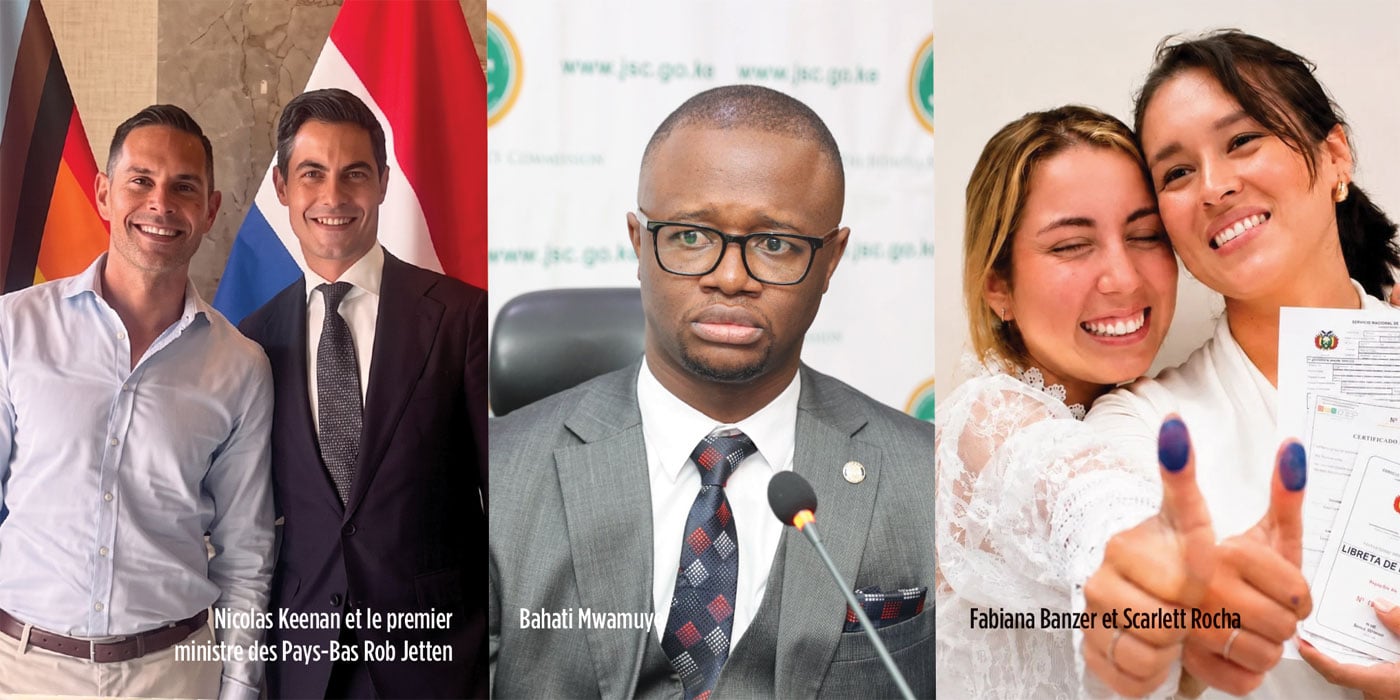
HERO — Netherlands centrist Democrats 66 party leader Rob Jetten, who was sworn in as Prime Minister on February 23 at age 38, becoming the country’s youngest and first openly gay prime minister.
HERO — The Netherlands, which banned gay conversion therapy on June 16.
ZERO — Pride in London chief executive Christopher Joell-Deshields, who was dismissed on April 2 after being accused of purchasing luxury goods for personal use with vouchers intended to cover volunteers’ food and drinks.
HEROES — The estimated 150,000 people who marched in London Trans+ Pride on July 26, the world’s largest transgender Pride event.
HERO — German Green Party politician Dominik Krause, who was elected mayor of Munich on March 22, marking the first time the Greens — and an openly gay politician — had taken control of Munich City Hall.
HERO — The European Parliament, which voted 340 to 141, with 68 abstentions, on February 12 in favour of a landmark, albeit largely symbolic, resolution affirming that “trans women are women.”
HERO — Spain, which topped ILGA-Europe’s 18th annual Rainbow Map ranking of LGBTQ rights on May 12, then approved a draft law banning conversion therapy on June 27.
HERO — Greece’s Council of State, the country’s highest administrative court, which ruled on March 20 that same-sex marriage and adoption by same-sex couples are legal.
ZERO — Türkiye, for escalating its persecution of LGBTQ people in 2026. Authorities arrested more than 50 people during an Istanbul Pride march on June 28, barred a 2,000-passenger Atlantis gay cruise from docking in Kuşadası on July 7, and arrested some 200 people during September 13 raids on gay bars, LGBTQ non-profit offices and activists’ homes across the country. When demonstrators protested outside Istanbul’s Çağlayan courthouse on September 15, police arrested another 150 people as protesters chanted, “Long live life in defiance of hate!” ILGA-Europe reported that another 45 LGBTQ people were arrested on October 23 in Ankara, Diyarbakır, Mardin, Çankırı, Istanbul, Bolu and Antalya.
HERO — Serbian Prime Minister Ana Brnabić, who became the first openly lesbian president of a Balkan country, taking office on September 28 after Aleksandar Vučić resigned earlier that day.
HEROES — The thousands of marchers who participated in a Pride march in Oradea, western Romania, on July 25, despite the municipality having banned the event for four consecutive years. Military police fined participants as marchers chanted, “I don’t care, I love it!”
HERO — The European Court of Justice, which ruled on April 21 that Hungary’s anti-LGBTQ laws, enacted by Viktor Orbán’s government in 2021, violate European Union rules and infringe equality and minority rights. The ruling came nine days after Hungarian voters removed the authoritarian Orbán from office.
HEROES — Hungarian lawmakers, who voted 139 to 51 on October 13 to repeal anti-LGBTQ provisions in the 2021 “child protection” law adopted under authoritarian former leader Viktor Orbán.
HERO — Warsaw, Poland, which registered its first same-sex marriage on May 14, implementing court rulings requiring the country to recognize same-sex marriages performed abroad. Same-sex couples still cannot legally marry in Poland.
ZERO — Belarusian lawmakers, who passed a law on April 2 allowing the government to intensify its crackdown on LGBTQ advocacy. According to the Associated Press, the legislation punishes those found guilty of “propaganda of homosexual relations, gender change, refusal to have children, and pedophilia” with fines, community service and up to 15 days in jail.
HEROES — The 5,000 people who joined Kyiv’s 10th annual Pride march on June 21. The demonstration lasted two hours and concluded as Russia launched a drone attack on the Ukrainian capital.
ZERO — Russia, for escalating its persecution of LGBTQ people in 2026. On January 31, the Moscow City Court fined 22-year-old David Gevondyan for posting a social media image of Queen frontman Freddie Mercury in drag. On April 13, the Oktyabrsky District Court fined citizens up to 500,000 rubles (approximately $8,500 CAD) for posting online reviews of the hit television series Heated Rivalry. On April 21, Russia’s Investigative Committee raided the Moscow offices of publisher Eksmo over LGBTQ-themed books for teenagers and young adults. The St. Petersburg City Court declared the Russian LGBT Network an “extremist” organization. And on June 29, a court in Orenburg sentenced the owner of the LGBTQ nightclub Pose to seven years in prison and a fine of one million rubles (approximately $17,000 CAD).
ZERO — Norwegian citizen Arfan Bhatti, who was sentenced to 30 years in prison by a Norwegian court on January 16 for orchestrating the deadly shooting at a gay bar during Oslo’s 2022 Pride celebrations. The attack was carried out by Norwegian gunman Zaniar Matapour, who killed two people and wounded eight. Matapour was also sentenced to 30 years in prison in July 2024.
HERO — The Philippine Supreme Court, which ruled on February 5 that same-sex couples can co-own property.
ZERO — Malaysia, which blocked access to queer dating apps Grindr and Blued on February 25 as part of its ongoing crackdown on LGBTQ visibility. Same-sex sexual activity remains prohibited under the Muslim-majority country’s colonial-era Federal Penal Code.
HERO — Nepal’s Supreme Court, which ruled in favour of legalizing same-sex marriage on June 18. The ruling makes Nepal the 40th country in the world to legally recognize marriage equality.
ZERO — The two unidentified assailants on a motorcycle who shot and killed Punjabi LGBTQ influencer and makeup artist Mad Sandhu on October 3 on Loharka Road in Amritsar, in the Indian state of Punjab.
ZERO — Anti-gay gunman Ousman Ceesay, who shot and killed two patrons of the Venture-N gay bar in Tucson, Arizona, on August 31 before taking his own life.
ZERO — German Islamist terrorist Abdul Ballout, 21, who killed one person and injured 29 others on July 26 when he drove a white van into a crowd at Berlin’s Pride festival, known as Christopher Street Day, in Tiergarten Park. Police later shot and killed Ballout.
HERO — Fierté Montréal, which increased security at its Pride festival, held from July 31 to August 9. The organization said 10 per cent of its overall budget was devoted to security measures coordinated with Montreal police, the Sûreté du Québec and other public-safety partners.
HEROES — LGBTQ advocacy organizations Helem and Mosaic, which opened a shelter for displaced LGBTQ people in Lebanon following Israeli strikes against the Lebanese armed group Hezbollah that began on March 2, Reuters reported on May 6. The shelter’s location remains secret to protect its residents from possible hostility within conservative segments of Lebanese society.
ZERO — The Trump administration, which ordered the National Park Service on January 21 to remove a large Rainbow Flag from a flagpole at the Stonewall National Monument, the birthplace of the modern LGBTQ rights movement, at Christopher Park near the Stonewall Inn. On April 13, a legal settlement in the U.S. District Court for the Southern District of New York secured the flag’s permanent return, ending a high-profile lawsuit filed by the Gilbert Baker Foundation, Village Preservation, Equality New York and others.
ZERO — Viciously anti-gay U.S. Republican Senator Lindsey Graham, who died on July 11 at age 71.
HERO — Kenya’s Court of Appeal, which ruled on January 23 that the Kenya Film Classification Board’s ban on the 2018 film Rafiki, for its alleged “overt promotion of lesbianism,” was unconstitutional and violated freedom-of-expression protections.
HERO — Kenyan High Court Justice Bahati Mwamuye, who ruled on May 20 that Kenyans may change gender markers on official documents, in a landmark decision supporting transgender and intersex people.
HERO — Botswana, which officially amended its Penal Code on March 26 to repeal colonial-era anti-LGBTQ laws.
ZERO — Senegal, which passed a law on March 11 doubling the maximum prison sentence for same-sex sexual acts to 10 years and criminalizing efforts to promote homosexuality.
ZERO — Ghana’s Parliament, which approved the Human Sexual Rights and Family Values Bill on May 29, criminalizing the so-called promotion of LGBTQ activity. Offenders face up to five years in prison.
ZERO — Niger’s military junta, which adopted legislation in February criminalizing consensual same-sex relations between adults, as first reported on June 11. The offence carries a prison sentence of five to 10 years and a fine of up to €150,000.
ZERO — Anti-gay Jamaican reggae and dancehall veteran Sizzla Kalonji, whose September 4 single “Creation Order [Bun Out]” expresses his opposition to homosexuality and what he calls the “homosexual lifestyle,” while celebrating his attraction to women. Sizzla also made anti-LGBTQ comments onstage at the Reggae Nation Montréal Festival in the city’s Old Port on September 6.
HERO — The first-ever Kréyòl Pride, held on July 25 in Basse-Terre, Guadeloupe.
HERO — The London-based Judicial Committee of the Privy Council, the highest court of appeal for several former British colonies, which ruled on November 10 that Trinidad and Tobago’s colonial-era laws criminalizing gay sex are unconstitutional. Trinidad and Tobago was one of 34 Commonwealth countries that continued to criminalize homosexuality under laws inherited from British colonial rule. The ruling concludes an 11-year legal battle brought by dual citizen Jason Jones, 62.
HEROES — Fabiana Banzer and Scarlett Rocha, who became the first same-sex couple to have a civil marriage officially registered in Bolivia on August 7, following a four-year legal battle.
HERO — Ecuador’s Constitutional Court, which ruled on March 10 that people under 18 cannot automatically be denied the right to request a change of gender marker on their identity documents.