

From remarkable athletic achievements and historic firsts to acts of solidarity and controversies over inclusion, 2026 once again demonstrated that sports remain a battleground for LGBTQ+ rights and visibility. While athletes broke barriers and inspired new generations, some sports federations and institutions moved to restrict transgender participation, fueling increasingly polarized debates. For the 31st consecutive year, Richard Burnett looks back at the athletes, teams and decisions that shaped the sporting world, for better or worse. Here are his Heroes and Zeroes of 2026 in sports.
ZEROS — Egypt and Iran, which asked FIFA to cancel their scheduled World Cup match at Seattle’s Lumen Field on June 26 because it coincided with the city’s Pride celebrations. The match was designated the tournament’s first-ever Pride-themed game. Both Egypt and Iran criminalize homosexuality, and Iran executes people for same-sex sexual conduct. The match went ahead as scheduled. While Qatar, which hosted the 2022 FIFA World Cup, had banned rainbow armbands, flags and banners, FIFA permitted fans to wave rainbow flags inside the Seattle stadium this time.
HEROES — The eight footballers, among the 1,248 players at the 2026 FIFA World Cup, who publicly supported LGBTQ civil rights, despite there being no openly gay players in the tournament: Borja Iglesias (Spain), Jackson Irvine (Australia), Bruno Fernandes (Portugal), Harry Kane and Marcus Rashford (England), Manuel Neuer and Leon Goretzka (Germany), and Patrick Berg (Norway).
HERO — Referee Brooke Mayo, who, on June 18, became the first openly gay official at a men’s FIFA World Cup when she served as an assistant referee for the Czech Republic–South Africa match in Atlanta.
HERO — German football referee Pascal Kaiser, who was attacked by three men in his garden on February 7 after proposing marriage to his partner on the pitch at Cologne’s RheinEnergieStadion, in front of 50,000 spectators, before a January 30 match between FC Köln and VfL Wolfsburg. Kaiser was attacked again by two assailants outside his home on February 9.
ZEROS — San Francisco Giants pitchers Landen Roupp, JT Brubaker and Ryan Walker, who wrote the Bible verse “Genesis 9:11–16” on their caps during the Giants’ June 12 Pride Night game. Rather than taking a stand for inclusion, Giants President of Baseball Operations Buster Posey deflected questions about the incident at a June 23 press conference. Two days later, an exasperated Giants CEO Larry Baer acknowledged, without offering an apology, “Yes we could have handled things better this year for sure.” On July 14, MLB Commissioner Rob Manfred sided with the Giants, dismissing the controversy with a curt “End of story.”
HEROES — The 33 Bay Area clergy members and faith leaders who signed a public letter on June 22 condemning San Francisco Giants players for writing Bible verses on their Pride Night caps. The letter also criticized the Giants organization for its tepid response. “It’s not okay to use my faith tradition as a weapon in that way to make people feel unsafe and unwelcome,” said Rev. Dr. Kelly Colwell, senior minister at First Church Berkeley UCC.
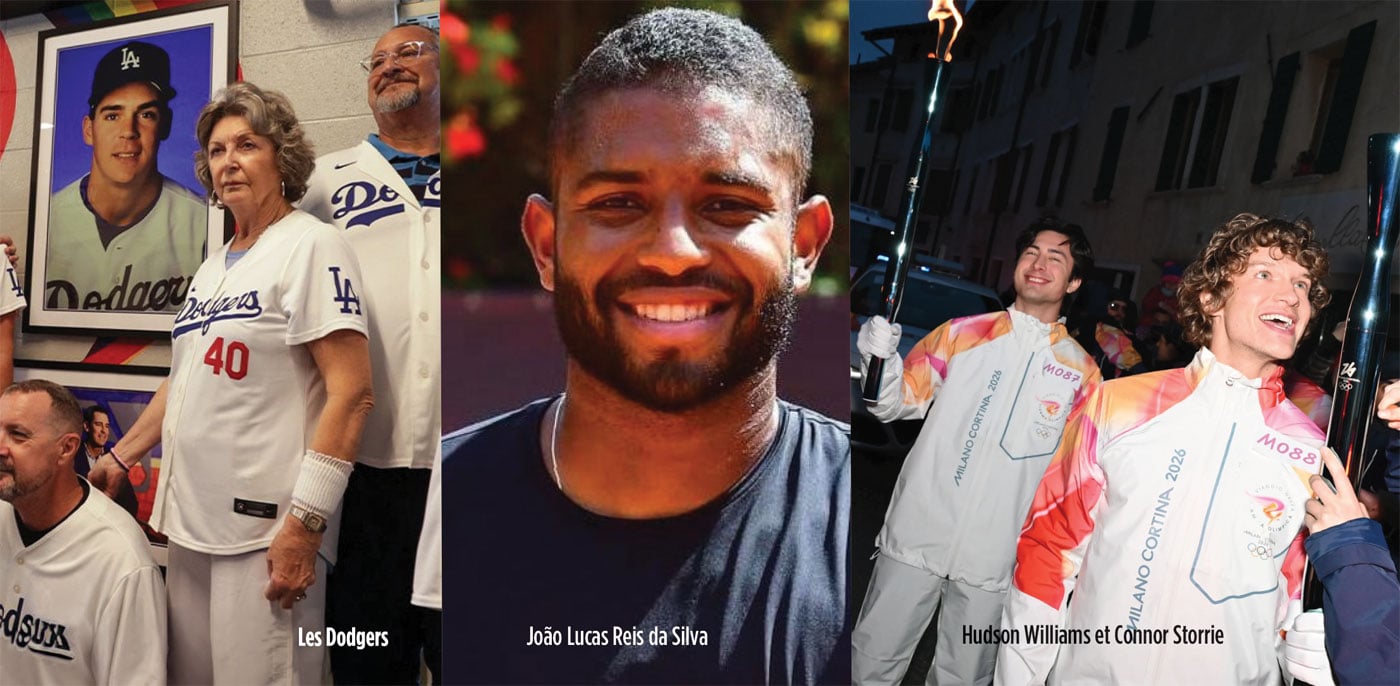
HERO — The Los Angeles Dodgers, who unveiled a new display at Dodger Stadium during their June 5 Pride Night honouring former Dodgers Glenn Burke and Billy Bean, the first two known gay players in Major League Baseball. The display recognizes their contributions to baseball and the LGBTQ sports community.
HEROES — Brazilian ATP tennis player João Lucas Reis da Silva, 26, and Swiss player Mika Brunold, 21, whose September 13 match at the Tulln Challenger marked the first professional men’s tennis final between two openly gay players. Brunold won 6–4, 6–3. After the match, Brunold told Reis da Silva on court, “I also want to thank you. One year after your coming out, I did mine, and you were a big inspiration for me, and I’m really proud of us. We can be role models for so many people who struggle with their sexuality.”
HEROES — The 50 openly LGBTQ athletes representing 13 countries, including Canada, who competed at the Milano Cortina Winter Olympics from February 6 to 22. By comparison, there were 36 openly LGBTQ Olympians at the 2022 Winter Games, 15 in 2018 and seven in 2014. At Milano Cortina, openly LGBTQ athletes won 11 medals — five gold, two silver and four bronze — which would have placed a hypothetical Team LGBTQ 13th in the overall medal standings. Meanwhile, six openly LGBTQ Paralympians competed in five sports at the Milano Cortina Winter Paralympics, held from March 6 to 15. American cross-country skier Jake Adicoff became the first openly gay man to win an individual Winter Paralympic title. Competing in the vision-impaired category, Adicoff won four gold medals.
HEROES — Heated Rivalry breakout stars Hudson Williams and Connor Storrie, who took part in the Olympic torch relay on January 25 ahead of the Milano Cortina Games.
RELUCTANT HEROES — Montreal Canadiens players Nick Suzuki, Juraj Slafkovsky, Alexandre Texier and Oliver Kapanen, who completely froze when asked about Heated Rivalry during the January 25 broadcast of Tout le monde en parle. Fortunately, Canadiens captain Suzuki salvaged the cringe-worthy moment with what sounded like prepared talking points about the series. The segment was hardly likely to encourage gay hockey players to come out — if anything, it reinforced the reasons they might hesitate. Unsurprisingly, the next day, Canadiens Vice-President of Communications Chantal Machabée told Global News, “We are an inclusive team, we welcome everyone.”
ZERO — Anaheim Ducks defenceman Radko Gudas, who represented Czechia at the Milano Cortina Winter Olympics. Before Canada narrowly defeated Czechia 4–3 in overtime, footage from the February 18 quarterfinal showed Gudas shouting, “Get off your fucking knees, you fucking cocksucker!” while protesting a two-minute roughing penalty involving Canadian left winger Brandon Hagel. Gudas received no additional penalty during the game and faced no subsequent disciplinary action from the IIHF or IOC.
ZERO — The International Olympic Committee, which adopted a new eligibility policy on March 26 banning transgender women from women’s Olympic events, aligning with U.S. President Donald Trump’s executive order on sports. The policy is scheduled to take effect at the 2028 Los Angeles Summer Olympics. IOC President Kirsty Coventry, a two-time Olympic gold medallist in swimming, declared, “It is absolutely clear that it would not be fair for biological males to compete in the female category.”
ZERO — The U.S. Supreme Court, which upheld state bans on transgender girls and women competing in girls’ and women’s school sports on June 30, delivering a major victory to Republican-led states. In a 6–3 decision written by Justice Brett Kavanaugh, the Court ruled that laws in Idaho and West Virginia did not violate the Equal Protection Clause or Title IX.
ZERO — The Women’s Tennis Association, which introduced a mandatory one-time genetic test for all players on July 21. The test screens for the SRY gene, a segment of DNA typically found on the Y chromosome. The WTA became the first professional sports league to introduce such testing. On August 3, WTA champion Aryna Sabalenka supported the policy, saying, “Biologically men are way stronger than women, so I feel like it would be not really fair for the woman to compete against biological man.” Martina Navratilova and Chris Evert also supported the new policy, while Billie Jean King argued that excluding transgender women from women’s sports is discriminatory.