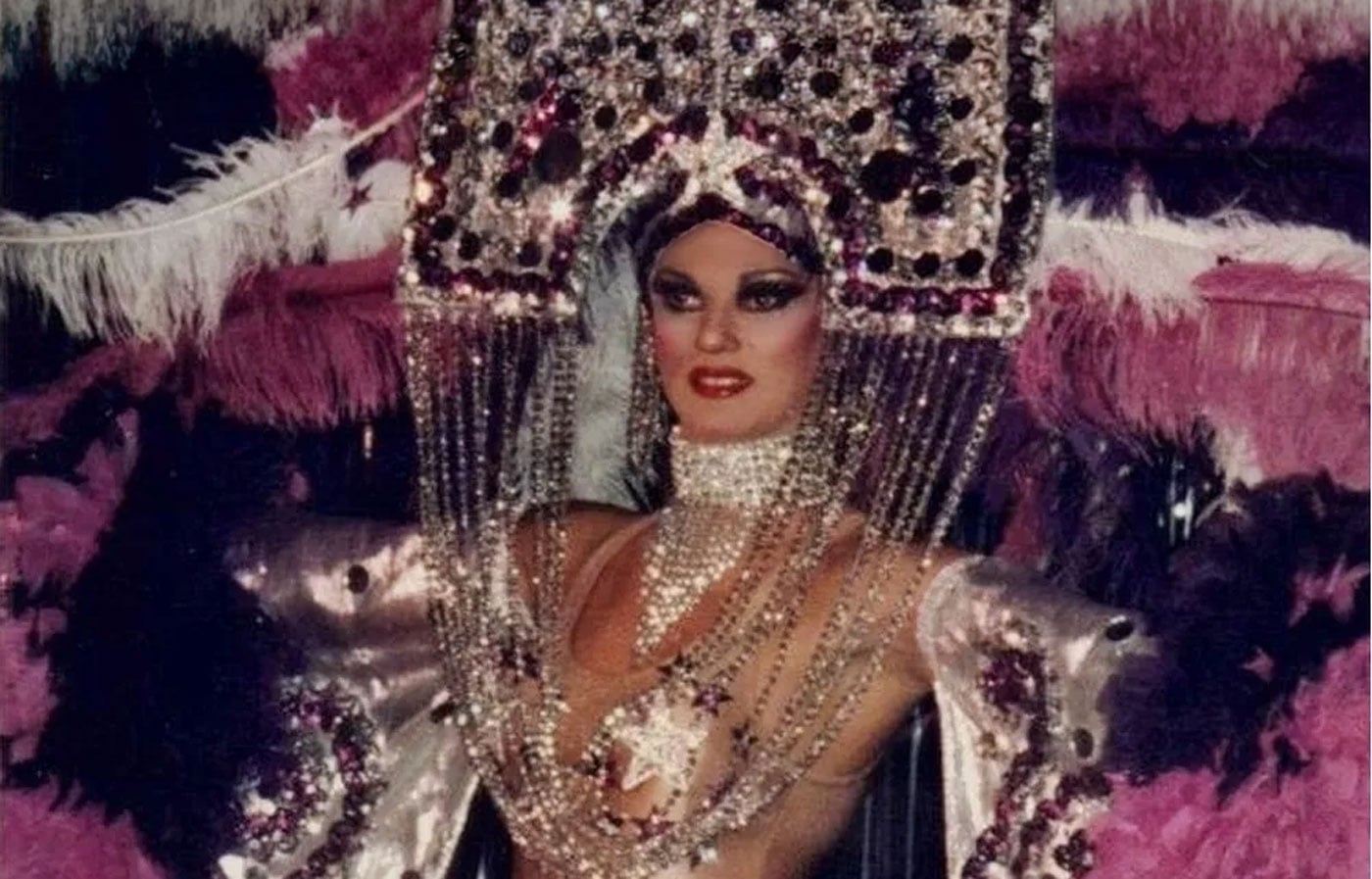


Montreal drag pioneer Vicky Lane’s five-decade drag career is the stuff of legend. Born and raised on Chicago’s South Side before moving to New York at age 17, Vicky began performing regularly at the Hotel St. George in Brooklyn after appearing there as a DJ in drag.
After the Stonewall Riots of 1969, Vicky toured extensively with the Fantasy Follies, performing across Canada and the United States, sometimes for 51 weeks a year and up to 300 shows annually. Vicky made her Montreal debut at PJ’s cabaret on Peel Street in 1972 when the downtown West Village was the centre of LGBTQ nightlife in Montreal.
After marrying his wife Laura in 1979 and raising their two sons (“Our life together has been fantastic and we still care for each other”), the bisexual Vicky was based at iconic drag bar Café Cléopatre for 14 years, even appearing with drag icon Guilda in the classic Italian-made Dirty-Harry-style action thriller Blazing Magnum filmed in Montreal in 1976, and which features one of the greatest car chases ever filmed.
Vicky participated in countless charitable shows and events supporting people living with AIDS for years before retiring from the stage for good in 2005. I recently visited Vicky at her West Island home, and her candid Q&A has been edited for length and clarity.
You were born in Chicago in 1950. What was it like growing up in Chicago?
Vicky Lane: I grew up on the South Side which could be a little rough. I was hanging out on the North Side, which was the gay side. But I never came out to my parents. Coming out to your family back then was not common. I knew I needed a change and my mother told me, “Sometimes you have to go somewhere else and start anew.” So I decided to move to New York. My mother was kooky but was very supportive of me, and even gave me money when I left for New York in 1967.
What was New York like when you arrived?
Vicky Lane: I freaked out because I was alone with little money. I got three jobs with a theatre ticket service. I was the youngest ticket broker on Broadway at the time. It took me about a year to find my circle of friends.
How did you discover drag?
Vicky Lane: When I was the doorman for a gay bar called The Gold Bug in Greenwich Village. I saw my first drag queens there. But they were always a pain in the ass, always starting trouble and fighting. So I had to help get these drag queens up the stairs and out the door. That’s why I disliked them. But little did I know that within a year I’d become a drag queen!
When did you first dress in drag?
Vicky Lane: I was working all these jobs and devoting my extra time to the Deborah Hospital in New Jersey. I came up with the idea of creating shows to raise money for the hospital, and I had these friends, three queens who were going to be The Supremes. They challenged me to try drag, so the next year I did a number and I really liked the applause. I realized that I wanted more. So we did more shows. One day our emcee asked why were we donating all of the money to Deborah? So we started to keep the money. That’s when drag became a career.
During the Stonewall Uprising, you performed regularly at the Hotel St. George, a hub of gay male life in Brooklyn. What was that like?
Vicky Lane: I was also becoming a DJ. I brought my sound equipment to a club and would DJ there for a few weeks. I was working three clubs including a club at the Hotel St. George where one day I showed up in drag for the fun of it. Ty Burnett, emcee of the 82 Club. and Gene Chandler from the Jewel Box Review, saw me and encouraged to DJ in drag all the time.
You, Gene Chandler and Ty Bennett would later famously tour together as the « Fantasy Follies » drag revue. Is that how you got your stage name Vicky Lane?
Vicky Lane: Ty told me that it was good luck if an older drag gave you your name. My name was Marty Mendoza and my drag name was Vicky Mendoza. So Ty renamed me Vicky Lane during Stonewall where Gene was one of the protestors.
Did you ever go to the Stonewall?
Vicky Lane: No, but the police in New York City were terrible. I remember queens telling me they always kept a little bit of extra money in their underwear just in case they got arrested. Many people I knew were in the front lines at Stonewall. It was scary. But I never got hassled in the streets. New York was never as rough as Chicago. I could go wherever I wanted in drag and I never got arrested by the cops for being in drag.
You performed as a female impersonator and drag queen across Canada and the U.S. East Coast, including legendary summer runs at the Fun Spot in Wildwood, New Jersey. What was the Fun Spot like?
Vicky Lane: It was a straight club AND it was a tourist trap! But gay men used to come in to see us perform all the time. After three years the Fun Spot asked me to do my own show. And the Fantasy Follies revue that I started with Gene Chandler and Ty Bennett at the Hotel St. George, we toured for about 15 years from 1969 to the 1980s. We had a station wagon that pulled a trailer filled with our costumes, and we drove from town to town. We worked like hell. We didn’t do one-nighters or two-nighters. We would headline a venue for five or six nights per week. At our peak we did 300 shows a year. We worked 51 weeks per year. And that’s no exaggeration.
You first performed at PJs in Montreal in 1972. PJs emcee Armand Monroe told me, “Vicky Lane was very young, she was gorgeous and one of the best performers we ever had.” What was it like to work at PJs with Armand?
Vicky Lane: I’m not sure if it was Armand who first booked us there. I think it was Al Simkin who was the manager. He came to New York City, saw us in a club on 71st and Broadway, and asked us if we would come to PJs, and we said yes. Touring back then was rough because drag wasn’t as accepted. When I started, we were still called female impersonators. That’s why I always loved Montreal and the province of Quebec: we were always treated nicely here. We played at PJs for about 4 or 5 weeks. They loved us! There were lineups going down Peel Street and around the corner on Saint Catherine. You had to wait hours to get in! And while he could be abrasive, Armand and I always got along. I remember one night after closing PJs, we shared a cab up Parc Avenue where he got out to go cruising on Mount Royal wearing just a caftan with nothing underneath!
You performed with Montreal drag legends Guilda and Lana St-Cyr.
Vicky Lane: Lana was a sweetheart. She never said a bad word about anybody. She was very kind, and she came to our house for supper two weeks before she died in 1986. As for Guilda, she used to come by the house with new dresses for me to try on! We worked on a movie together called Special Magnum (also known as Strange Shadows in an Empty Room and Blazing Magnum in other countries). I got Guilda that movie booking. I was at PJs one night, and some guy asked (drag performer) Danny Solari, “Do you want to be in a movie?” And he said, “No, I don’t. But this queen over here might want it.” And I said, “Why not? How much are you paying?” He said something like $50. So I went to the film board, and instead of 50 bucks we got $650. That’s Guilda, Gene Chandler and me in the movie. I’m the drag queen sitting at the makeup table.
You headlined at Café Cléopatre for 14 years!
Vicky Lane: When I worked at Cleopatra, people used to think that I had some kind of sway because I worked there for such a long time. It was a very interesting time. I got to know a lot of the working girls, and a lot of them didn’t know me out of drag. I was always treated well at Cleo’s. I never had to ask owner Johnny (Zoumbalakis) for a raise. He was always a sweetheart. To this day, people say Cleo’s was the best place to go to see a show because we put on real floor shows with big costumes. I was also the very first drag queen to perform at Cabaret L’Entre-Peau!
Over the course of your career, how many outfits did you have?
Vicky Lane: Thousands! I used to make costumes and they lasted forever. I kept none of them after I retired in 2005. (Drag queen) Chantal Robert bought a lot of my costumes. Many are still out there. The only thing I have left is one set of tits. And the trophies that I won.
How do you feel about being revered as one of our drag pioneers, and being called a living legend – because you are Vicky!
Vicky Lane: You know, it’s just something that I had a passion for. Drag was the only thing I ever did year after year after year. I always wanted to get better. More makeup and bigger costumes. Until I couldn’t do it anymore. But I loved every minute of it right until the very end.