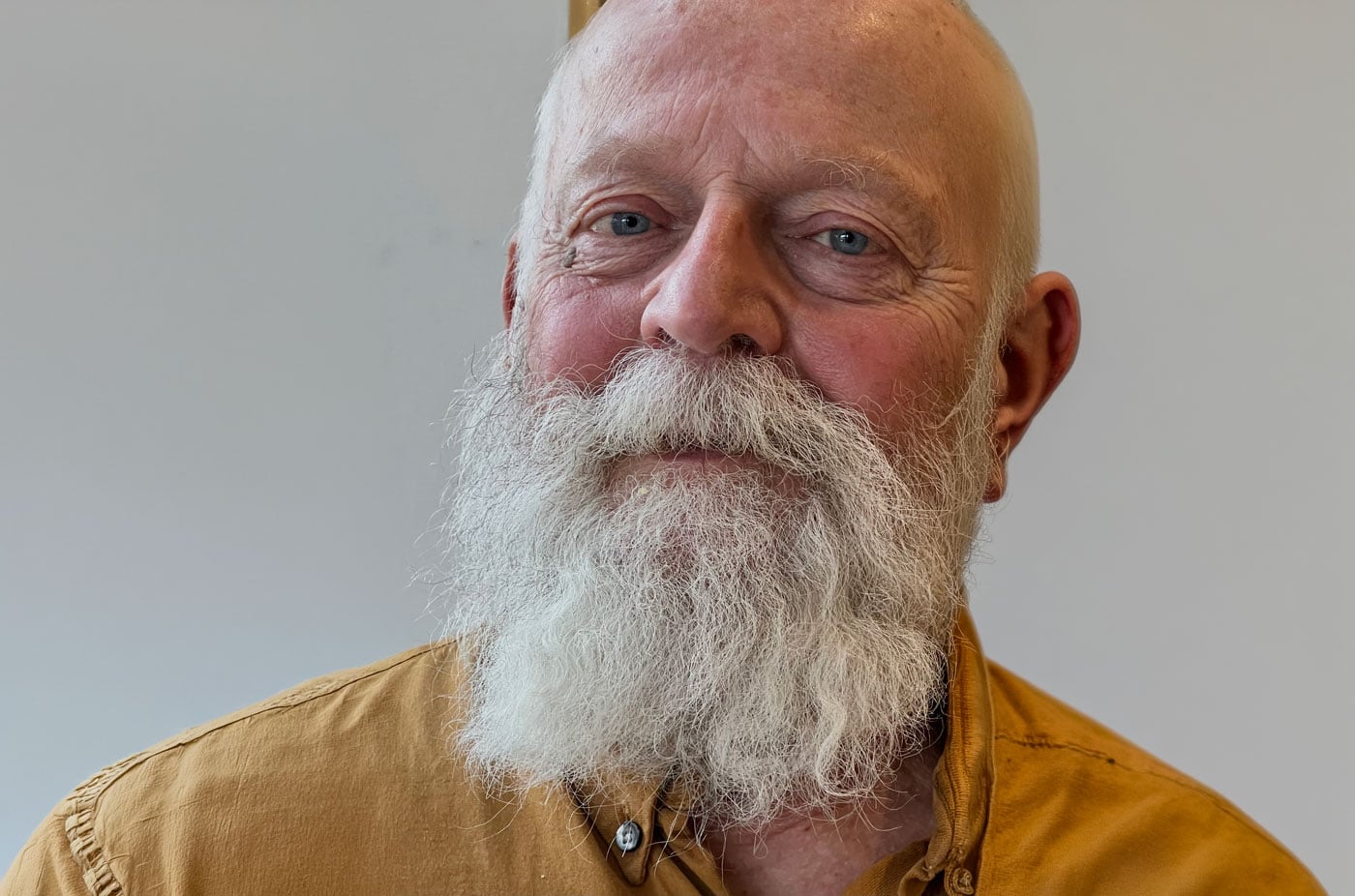

Montreal author Thomas Waugh describes himself as “a preacher’s kid who grew up to be a porn teacher.” Distinguished Professor Emeritus of Film Studies and Interdisciplinary Studies in Sexuality at Concordia University where he taught for 41 years, from 1976 to 2017, Waugh is a pioneer of queer film theory and criticism.
Waugh’s accomplished career at Concordia also includes organizing La Ville en Rose, Quebec’s first queer-studies conference in 1992; spearheading their minor in interdisciplinary studies in sexuality; founding the landmark Concordia Community Lecture Series on HIV/AIDS; and establishing the Queer Media Database Canada-Quebec Project.
Waugh has published many historical books over the decades, notably Hard to Imagine: Gay Male Eroticism in Photography and Film from their Beginnings to Stonewall (1996) and Outlines: Underground Gay Graphics From Before Stonewall (2002).
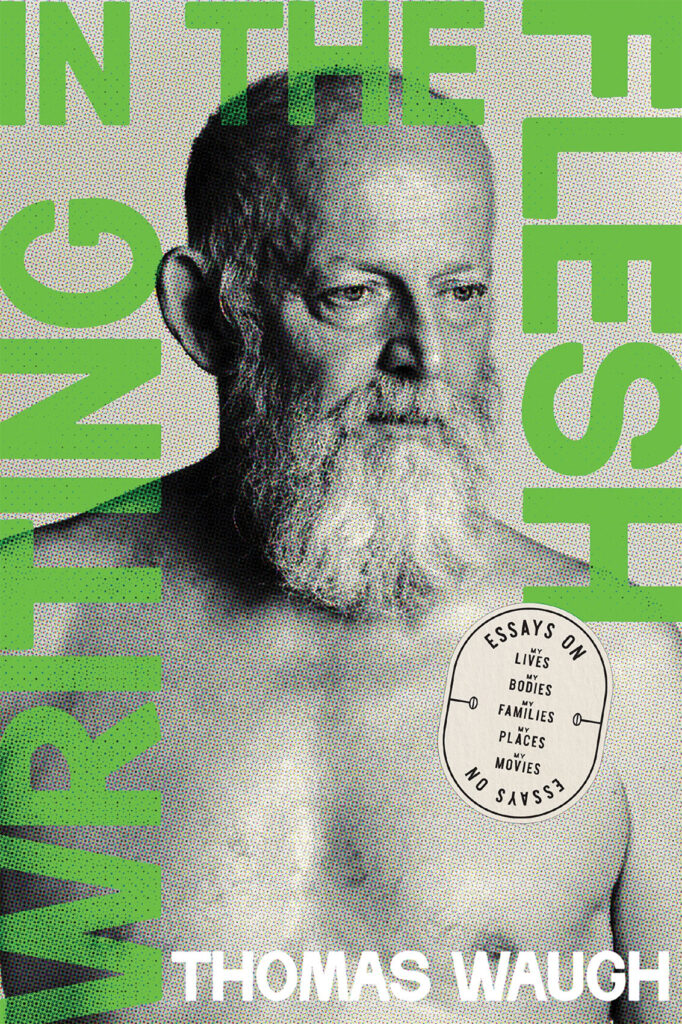
On the cover of his just-published memoir Writing in the Flesh: Essays on My Lives, My Bodies, My Families, My Places, My Movies (McGill-Queen’s University Press), Waugh looks like a modern-day Plato or Aristotle in a photograph taken by Montreal photographer Nick Bostick.
Waugh, now 78, recently sat down for a candid Q&A.
You began writing your memoir in 2020. How did you decide what to include?
Thomas Waugh: I am a very frank person, and discretion is not one of my strong points. There wasn’t much self-censorship going on. I wanted it to make sense to people outside of my milieu.
Was this book more difficult to write because it is your most personal?
Thomas Waugh: I think in some ways it might have been easier. I didn’t have to maintain a scholarly apparatus too much. I mean, there are lots of citations and footnotes, but not the kind of rigorous and anal academic apparatus that scholarly books have to have. So it was a pleasure writing it and going through old family snapshots. As the oldest living person in my family, I discovered that I’m sort of the patriarch of this family.
There are a lot of revealing photos! How did you deal with consent for stories, anecdotes and photos in your memoir?
Thomas Waugh: There are eight or nine wonderful drawings by artist Cumpug. He did these based on photographs of people that I was a little wary about exposing. I gave lots of people pseudonyms if I was a bit nervous, and I got permission and trust from the others. I’m honoured they gave me their permission, and I hope they’re happy. I think they are. I haven’t received any death threats!
Bain Colonial – open since 1914 – figures prominently in your memoir, as well as in your life. When did you first discover this Plateau institution?
Thomas Waugh: I visited a few gay saunas from the 70s onwards, especially when I lived in New York. But they really weren’t my thing. I didn’t like anonymous sex, I preferred having sex with people I could get to know, whose names I knew.
I discovered the Russian and Turkish tradition steam bath when I was in my 40s and 50s when visiting my friend Steve in the former Soviet Union and in the Baltic countries. These institutions are wonderful, this shared space of sweat and masculinity and nudity and friendship. And I thought, since the 70s I’ve lived one block away from this Montreal steam bath. Why have I never gone there? So I went and it was wonderful.
The Colonial was a shared space between not only relatively discreet gay men and Jewish and Muslim clients, but especially Russians who wear their felt hats. I became a regular and eventually started dragging my friends there, and at some point in the present century also went with mature gay PhD students in my teaching career, with their consent, of course. We had wonderful discussions on the rooftop about queer theory and scholarly methodology. Though I eventually got into a little bit of trouble about mixing my scholarly pedagogical profile with my queer social profile, which I write about in my memoir.
You built a community around you a bit like The Radical Faeries, but without religion.
Thomas Waugh: I’m not very good at spirituality. This preacher’s son had religion forced down my throat for the first 20 years of my life.
I interviewed Gay Lit icon Edmund White many times, and finally met him in person at a literary salon at your home in 2013. There were some wonderful writers in attendance, including filmmaker Bruce LaBruce. I feel like you and Edmund were sex-positive kindred spirits. How did that salon come about?
Thomas Waugh: That’s very flattering to hear. I am sex positive. He’s my idol in many ways. May he rest in peace. Edmund came to town for the Blue Metropolis Montreal International Literary Festival, and a friend – I honestly don’t remember who – connected with him and invited him over. It was wonderful!
In your memoir you write that you are a body hair fetishist and absolutist. What do you think of gay men who rid themselves of their body hair?
Thomas Waugh: I try to prevent them. I mean, I’m very forgiving. If I meet a new friend and he has stubble on his chest, I try to look the other way. But in ninth grade I was like a pre-pubescent four-eyed intellectual, and all my friends had turned into sexy, hairy teenagers. But not me. We would go to gym class, and our gym teacher would say, “Hit the showers, boys!” And I freaked out: “What’s wrong with me?” It became a kind of erotic fetish as I moved through high school and to this day I guess I’m a locker-room queen. It was very formative.
What was it like to write for The Body Politic?
Thomas Waugh: I really thought I was on the cutting edge. I loved their politics, and I was a bit envious that we didn’t have similar kinds of stuff going on in Montreal. I mean, there were good queer publications here, but nothing with the esprit de corps or the collective politics of The Body Politic. So I wrote for them and developed a kind of aesthetic of film criticism that had a political edge to it. I enjoyed working with that collective and being part of that history.
I first interviewed you for a March 1996 magazine cover story about how in 1994 you founded Concordia’s interdisciplinary course HIV/AIDS: cultural, social and scientific aspects of the pandemic, the first course of its kind offered at any university in North America.
Thomas Waugh: We were sort of a collective of committed faculty and students. The course assistants we had were wonderful. I’m very proud of the pioneering commitment. This was before triple therapy was introduced in 1996. We were living this crisis. People were dropping like flies. It was a very scary moment in time. And this was a response as an academic, a political response that needed to be made. And I think we had an impact. I still run into people who took the course from myself, or went to the public lectures, and they say it changed their lives. I’m very proud of that.
You write that your memoir was written “under the pall of my second pandemic.” Society demanded gay men adjust their lives in the wake of HIV, while so many people refused to adjust their lives in the wake of COVID. What did you think about their homophobic hypocrisy?
Thomas Waugh: The way people wandered around in 2020 talking about the pandemic as if there hadn’t already been a pandemic infuriated me.
I still have a gorgeous flyer postcard from La Ville en Rose, Quebec’s first queer-studies conference in 1992 which you organized. How did that conference help create community?
Thomas Waugh: It was a bilingual conference held at Concordia that really brought together Francophone and Anglophone queer academics in a way that hadn’t already happened. The two communities had not been talking much to each other. So we came together, listened and made wonderful discoveries about each other’s work and each other’s identities and writing, also across the gender divide. Academics also had a tendency to be isolated and not really care about what was going on with things like Sex Garage and the pandemic. So we had to confront that, and I think we made some breakthroughs. Tackling those divides was an important contribution we made. Thank you for remembering that.
In your memoir you write “I did not see myself at the age of 15 as part of a community.” More than 60 years later, as a veteran queer activist, you have seen many permutations of community over the decades. Is there a common denominator that drives community?
Thomas Waugh: It’s not a homogeneous community. The great strengths and assets of queer communities are that we are multiform, multigenerational and multicultural. I focus mostly on film. The richness and diversity of queer cinema in the present century is mind boggling. I’m currently organizing a screening to celebrate a new roommate moving in. We often have naked movie nights over here, and our next film will be Mambo Italiano.
That 2003 film was scripted by my BFF Steve Galluccio based on his signature hit play!
Thomas Waugh: It’s a part of this great wealth of diverse queer cinema. And it was made in Montreal!
When it comes to community, in our digital age, where are we today?
Thomas Waugh: Well, I’m a dissident. I don’t do social media. I much prefer marching in the streets, though I do it less now because I sort of wobble a bit now. But interpersonal and intergenerational contact and community and networks are so important. I love hanging out with people in their 20s who are discovering all these things, listening to them and challenging them. People in our 60s and 70s, this is our job. We have a responsibility to educate and challenge younger generations since so many of our contemporaries were lost in the first pandemic. We have to fill in for them.
How do you feel when people call you a living legend?
Thomas Waugh: It sounds like a Blackglama ad!
INFOS | Writing in the Flesh: Essays on My Lives, My Bodies, My Families, My Places, My Movies by Thomas Waugh is published by McGill-Queen’s University Press.